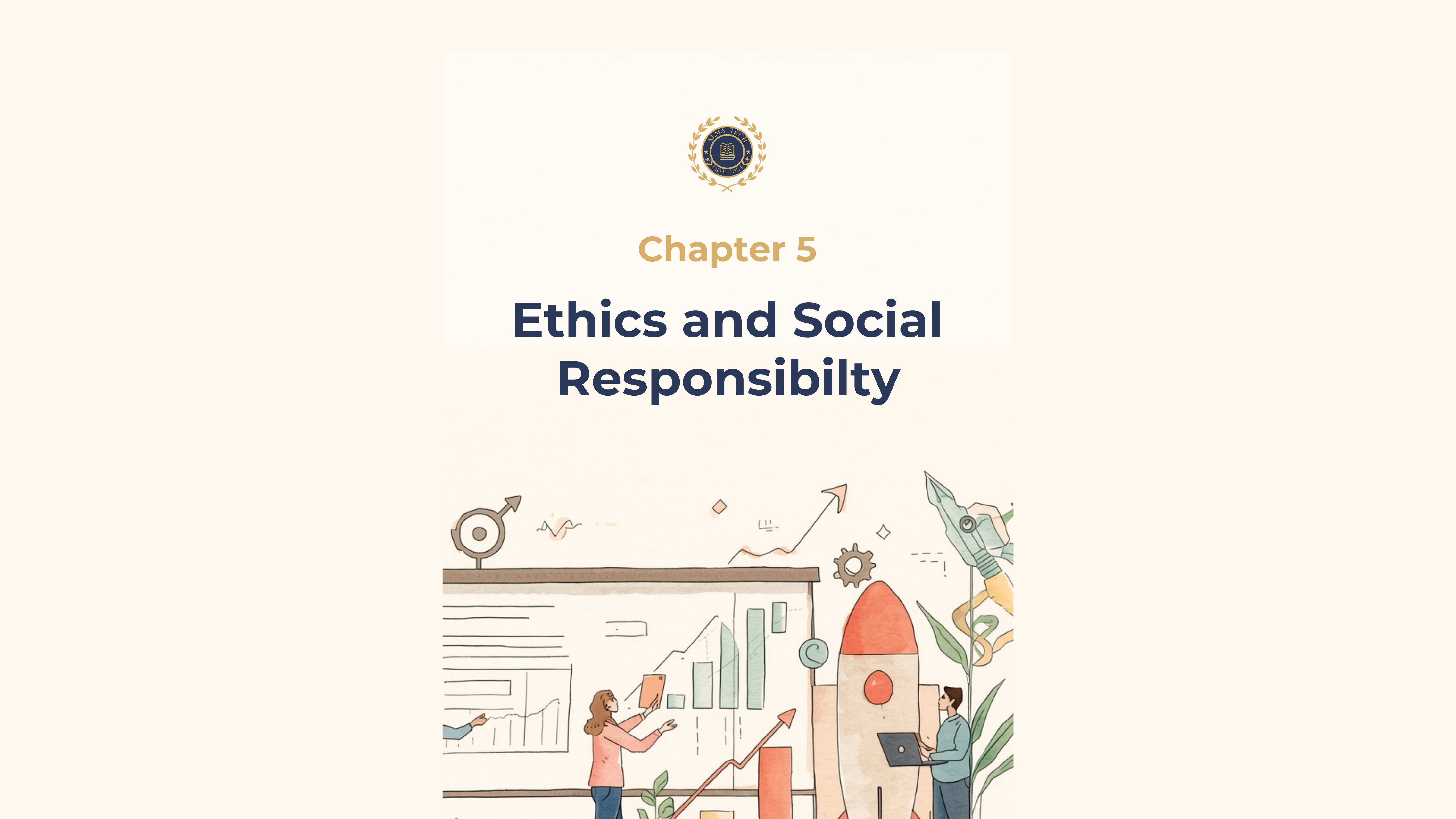
Ethics & Social Responsibility: Building Businesses with a Conscience
Success without ethics is like a ship without a compass — it may move fast, but it’s lost. In this final chapter, students learn one of the most important lessons in entrepreneurship: doing the right thing matters more than doing the easy thing.
Every decision an entrepreneur makes — from setting prices to hiring people — shapes their reputation and their impact on society. Ethics and social responsibility help students see that true entrepreneurship is not just about earning money; it’s about creating value responsibly.
This chapter teaches students that great businesses don’t just sell products — they solve problems, uplift people, and respect the planet. It builds the moral foundation every young leader needs before they step into the real world.
What Students Will Learn
1. Importance of Ethical Business Practices
Ethics are the invisible rules that guide fair decisions. Students explore what honesty, transparency, and integrity mean in business. Through real stories and classroom activities, they learn that ethical companies last longer, build stronger trust, and gain the loyalty of customers, employees, and society.
Example:
Companies like Tata Group and Infosys became Indian icons not only because of their profits, but because of their unwavering principles — fair trade, employee care, and truth in communication.
Students discuss scenarios like:
Should you raise prices during high demand?
How do you deal with customer complaints?
What happens when honesty costs money?
By debating such questions, they begin to shape their own moral compass.
2. Why and How Entrepreneurs Should Contribute to Society
A business doesn’t exist apart from society — it grows within it. Roads, schools, electricity, markets, and customers all come from the community. When businesses give back, they strengthen the same environment that supports them.
Students learn that contributing to society isn’t charity — it’s smart responsibility. It builds goodwill, improves brand image, and creates emotional loyalty.
Example:
Amul empowered rural farmers.
Reliance Foundation supports healthcare and women’s education.
Zoho Corporation trains rural youth in tech skills instead of hiring only from elite colleges.
These stories show how contribution and business success go hand in hand. Students are encouraged to think about small ways they can contribute — such as volunteering, supporting local vendors, or creating eco-friendly school projects.
3. CSR Norms and Real-World Examples
Corporate Social Responsibility (CSR) is the structured way businesses give back. Under India’s Companies Act (2013), large organisations must spend 2% of their average net profits on CSR projects that help society. Students learn what CSR is, why it’s required, and how it makes business more human.
CSR projects often support:
Education & skill development
Healthcare & nutrition
Environmental sustainability
Women empowerment
Rural infrastructure
Case Studies:
Infosys Foundation builds schools and funds rural education.
Tata Steel runs hospitals and tribal development programs.
Wipro invests in sustainability and community learning initiatives.
Students also study how bad CSR — superficial donations or fake campaigns — can backfire, teaching that responsibility must always be authentic.
Learning Experience
This chapter blends storytelling with reflection. Students read case studies, discuss moral dilemmas, and design their own mini CSR ideas for school-level projects. Teachers guide them to think critically — not only about what is profitable, but what is right.
They also engage in discussions about real-world issues such as climate change, gender equality, and fair wages — discovering that entrepreneurs have the power to influence all of them.
Outcome
By the end of this chapter, students will be able to:
Understand the importance of ethics in building trust and reputation
Make responsible business decisions under real-world pressure
Recognise their role in contributing to community development
Learn how CSR connects profit with purpose
Develop the mindset of an ethical, socially aware entrepreneur
Real-World Reflection
In business, your greatest asset is not your product — it’s your reputation.
Ethical founders may face slower beginnings, but they build companies that last for generations. Customers forgive mistakes, but they never forgive dishonesty.
Through this chapter, students learn that ethics and responsibility are not limitations — they are strengths. They make your voice credible, your brand respected, and your journey meaningful.
An entrepreneur’s true success lies not just in what they build, but in how they build it.
Because when business becomes a force for good, profit turns into purpose — and legacy follows.